The workflow in detail
What runs at each phase, on which model, for which size, and where it stops
for you. The size tables here, and the sizes.tsv file step.sh reads
each spawn’s model and effort from, are generated from
.apm/skills/feat/sizes.json
by mise run diagrams; this page adds the explanations. Neither skill
holds a size table or a gate table: step.sh applies them.
Roles
/brief: phase 1, in its own context. Interviews you, proposes the size, writes the brief (or a capability map for huge ideas) and hasfeat-brief-reviewerread it fresh before you confirm it.- Coordinator: the session running
/feat, started from a clean context. It holds every gate and changes onlyfeat-state.md, through thestate.shandstep.shscripts (never by hand); it never reads code, report files, runs checks or edits artifacts. At each phase boundary it makes one Bash call,step.sh, which checks the agents’ reports, decides the gate, logs it, runs the base check and prints the next spawn with its model and effort; the coordinator writes the gate message and makes the spawn. Every call it makes re-reads its whole context, so it stays thin on purpose. - Phase agents: the
feat-*subagents. Each does one job, can’t talk to you, starts with no conversation history, and gets what it needs (paths, size, conventions, allowed hooks, rejected findings) in its prompt. Changes you ask for at a gate go back to the agent that owns the artifact.
Phases at a glance
| # | Phase | Runs in | Skills used | Produces | Gate |
|---|---|---|---|---|---|
| 1 | Brief | /brief (your session), then feat-brief-reviewer | interview-me | specs/briefs/<name>.md, or a capability map | hard (confirm the brief and the review’s findings) |
| 0 | Setup | coordinator | — | conventions, hooks checked | hard only if a Spec Kit hook won’t run (specify, plan, tasks, analyze) or would branch or commit |
| 2 | Specify | feat-specifier | speckit-specify | branch/worktree, spec.md, feat-state.md | hard only on an open question or a blocker; else soft, and its summary opens the next gate |
| 3 | Plan | feat-planner | speckit-plan | plan.md and design docs | none (hard for large, opening with the spec summary after a soft phase 2) |
| 4 | Design review | feat-design-reviewer ×1 (small) or ×3, then feat-planner writes accepted findings | security-and-hardening (cost and design checklists in the agent) | a paraphrase, findings D1… with recommendations | one gate with 3: hard only on a finding that needs you (user), a user-call assumption, a constitution violation, a blocker, a size increase, a paraphrase that contradicts the brief or an unchecked checklist item after a soft phase 2, else soft and the apply findings are applied (always hard for large) |
| 5 | Tasks | feat-tasker | speckit-tasks, speckit-analyze | tasks.md, analysis clean | hard on CRITICAL/HIGH, analyze not run, a size increase, an unanswered checklist item or tasks.md not matching the tasker’s report (story.sh); always for large |
| 6 | Implement | feat-implementer ×1 per user story, in turn | speckit-implement | the code, tasks ticked when their checks ran, a Not verified list | soft (hard per story for large; hard on a design problem) |
| 7 | Code review | feat-code-reviewer ×2 (small) or ×5, then feat-implementer applies the fixes | security-and-hardening, performance-optimization | findings B, S, P, C, R with recommendations; fixes applied | small/medium: hard on a finding that needs you (user), an S finding or an unmet criterion, else soft; large: hard |
| 8 | Ship | feat-shipper | — | docs updated, commits, push, PR | none |
Hard gate: Claude stops and waits for your answer. Soft gate: Claude
reports and continues, its one-line summary in the same turn as the next
spawn; anything surprising lets the coordinator turn it into a hard gate
(an override, logged). step.sh decides each gate of the table from the
agents’ reports and the Log; the gates are the ones the column says.
Every agent’s report ends with a Wrote: list (its artifacts and the
files it wrote, or none). step.sh refuses any path that is not
absolute, is outside the worktree, or holds a quote, newline, tab, $,
backtick or .. segment, then checks each path exists and that the
report’s own path and artifact path are on the list. A failure fails the
phase: a hard gate that shows the reason, with no automatic retry (“back to
N” reruns it). A report that does not parse (a field outside its fixed
values, a wrapped list item) gets one reformat turn: the same agent writes
it again in its format, changing nothing else; a second slip is a hard
gate naming the line.
Report files. Before each spawn, step.sh gets the agent a path from
state.sh report-path, <artifact dir>/reports/<key>.md (3-test-2.md on
a rerun; a report file is never overwritten). The agent writes its full
report there, one field per line with fixed values where step.sh reads
them, lists the path on Wrote:, and hands back a digest: what the gate
message needs beside step.sh’s output (each agent file lists its
fields). The coordinator never reads a report file. reports/ holds a
.gitignore with *, so it is never committed. The code and design
reviewers may write their report file and nothing else: step.sh takes a
state.sh snapshot before each batch of reviewers and runs state.sh unchanged after it, so any other change to the worktree is a hard gate
that lists the paths that changed. An agent given no report path
(/tiny’s reviewer, /brief’s) reports in full and writes nothing.
After a soft phase 2, the next gate (3/4, or 3 on large) opens with the spec summary.
From phase 3 on, step.sh starts each phase with the base check (see
When main moves): silent when main has not moved; a
move is listed at the next gate, or stops there when it needs your call.
Size × phase matrix
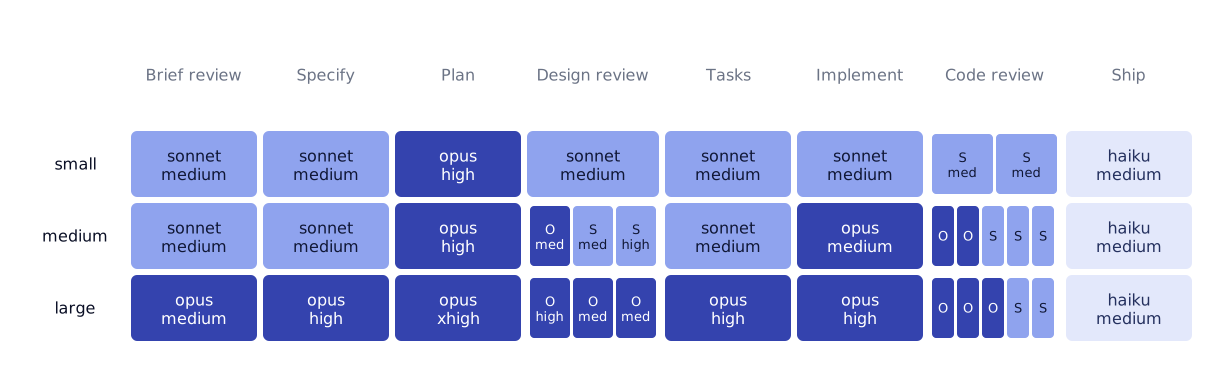
Opus where judgment decides, Sonnet for the routine work, Haiku to ship. A
split cell is a phase whose reviewers run in parallel, one per group of
lenses (O = Opus, S = Sonnet). The picture is drawn from
.apm/skills/feat/sizes.json by mise run diagrams.
Each cell: model · effort, printed by step.sh in every spawn block (from
sizes.tsv) and passed by /feat on the spawn.
| # | Phase | Agent | small | medium | large | huge |
|---|---|---|---|---|---|---|
| 1 | Brief | your session | session | session | session | session, plus capability map |
| 1 | Brief review (/brief) | feat-brief-reviewer | sonnet · medium | sonnet · medium | opus · medium | first capability’s size |
| 2 | Specify | feat-specifier | sonnet · medium | sonnet · medium | opus · high | — |
| 3 | Plan | feat-planner | opus · high | opus · high | opus · xhigh | — |
| 4a | Security design | feat-design-reviewer | sonnet · medium | opus · medium | opus · high | — |
| 4b | Cost design | feat-design-reviewer | sonnet · medium | sonnet · medium | opus · medium | — |
| 4c | Clarity and fit | feat-design-reviewer | sonnet · medium | sonnet · high | opus · medium | — |
| 5 | Tasks | feat-tasker | sonnet · medium | sonnet · medium | opus · high | — |
| 6 | Implement | feat-implementer | sonnet · medium | opus · medium | opus · high | — |
| 7a | Correctness, spec, standards | feat-code-reviewer | sonnet · medium | opus · medium | opus · medium | — |
| 7b | Security | feat-code-reviewer | sonnet · medium | opus · medium | opus · high | — |
| 7c | Performance | feat-code-reviewer | sonnet · medium | sonnet · medium | opus · medium | — |
| 7d | Over-engineering | feat-code-reviewer | sonnet · medium | sonnet · medium | sonnet · medium | — |
| 7e | Readability | feat-code-reviewer | sonnet · medium | sonnet · medium | sonnet · medium | — |
| 8 | Ship | feat-shipper | haiku · medium | haiku · medium | haiku · medium | — |
Phase 6 runs one implementer per user story, in turn.
Phase 4 reviewers. small: one reviewer, lenses 4a+4b+4c. medium and large: one reviewer per lens, in parallel.
Phase 7 reviewers. small: two reviewers, lenses 7a+7b and 7c+7d+7e. medium and large: one reviewer per lens, 7a–7d in parallel, then 7e
with 7d’s cuts. A group runs on the strongest model and effort among its lenses.
Applying the review fixes and moving onto a new main use the phase 6 row.
The groups are sizes.json’s groups, carried into sizes.tsv with
their precomputed model and effort.
A huge idea never reaches /feat as one unit: each capability of its map
gets its own brief and size column.
How the sizes differ beyond model and effort
| small | medium | large | huge | |
|---|---|---|---|---|
| When | up to ~30 tasks; no new service, permissions, network exposure or dependency; docs-only work | ~31–60 tasks, or a small one adding any of those | more than ~60 tasks | capabilities that could ship independently |
| Hard gates | brief, 7 (+2 on a question, +3/4 on a finding or checklist item, +5 on CRITICAL/HIGH or a task mismatch, +7 on a finding that needs you) | brief, 7 (+2, +3/4, +5 and +7 as for small) | brief, 3, 4, 5, each story in 6, 7 (+2 on a question) | the map |
| Design reviewers | 1 | 3 | 3 | per capability |
| Code reviewers | 2 | 5 | 5 | per capability |
| PRs | 1 | 1 | 1 | 1 per capability |
| Extra review | — | — | /code-review ultra suggested before merge (you launch it) | per capability |
Why these choices
- Plan is on Opus even for small. Plan quality decides everything after it, and it is one agent run.
- Effort before model. Raising effort on the same model costs less than a bigger model, and pays off most in planning and review.
- One implementer per story at every size. Each starts fresh instead of carrying the earlier stories’ reads; stories run one after the other because nothing is committed before phase 8.
- One design reviewer and two code reviewers for small. Each agent start costs ~36k tokens before any work; a small design doesn’t need three separate contexts, nor a small diff five. Lens 4c stays a fresh reader either way: no design reviewer gets the planner’s report.
- A fresh reader on every brief. One cheap spawn before anything is built; a wrong premise found in phase 4 has already cost a spec, a plan and the design reviews.
- Ship on Haiku. Commits, push and a PR body from the state file need little reasoning; it used to run at the coordinator’s full context.
- Huge is a scoping problem. One spec with a dozen capabilities gives a shallow review and a PR nobody can read.
Phase details
1 Brief (/brief)
Reads the code the idea touches, interviews you one question at a time
(interview-me steps 1–5; its restate is the brief, its confirmation the
gate, its hand-off step skipped), gives the strongest counter-argument to
each decision before writing it down, proposes a size and writes
specs/briefs/<name>.md: why, how it’s handled today, behaviour, out of
scope, alternatives rejected with their reasons, acceptance, constraints.
The path is anchored to the checkout’s top level (git rev-parse --show-toplevel: the repo, or its worktree), never a temporary dir; outside
a git checkout it asks for the repo’s path before the interview and stops
without one, and the board check, the reads and the write all use that
top level. Its last lines print the absolute path.
From an issue (/brief #N or its URL) it reads the issue with gh as
the idea and records it in the brief; the shipper’s PR says Closes #N.
With board tracking it checks the board first, moves the
issue to Brief, and after the gate offers to create the issue when the
brief has none. From a tiny brief (/brief <path>, what /tiny hands off
when the work outgrows it) it takes Why, Behaviour and Acceptance as
answered, asks for the missing sections, sizes it, and writes the full
brief under the same short name and issue in the checkout it runs in;
/feat refuses a Size: tiny brief.
Then feat-brief-reviewer reads the brief with no knowledge of the
interview, as the specifier will, on every brief. It makes four passes:
- clarity: it paraphrases what the feature does, for whom and how it’s handled today; the gate shows this so you can check it against what you meant;
- yagni: existing code, a dependency or a config option that already covers it (it searches and names the path), behaviour that could be dropped, a symptom fix, an obvious alternative neither chosen nor rejected;
- gap: undecided failure and edge cases, acceptance nobody could check, existing data or users the change affects, constraints the code contradicts, scope that leaks;
- size: its own task estimate; a higher size is asked, not applied.
Its passes are adapted from the brainstorm lenses and the Heilmeier and
feature-spec standards of the
Elephant-Goldfish Model
(Apache-2.0). Findings F… come with recommendations; the accepted ones are
written into the brief, and a rejected “drop this” goes under “Alternatives
rejected” with your reason, which the specifier, planner and reviewers
treat as settled. Then it tells you to /clear and run /feat on it.
Huge: writes a capability map to specs/maps/<name>.md (stable ids,
responsibility, size, one-way dependencies, a build order where each step
ships something usable), gates on it, then writes the first capability’s
brief. Detection rules and map format adapted from the scope check in
addyosmani/agent-skills'
spec-driven-development (MIT).
0 Setup (coordinator)
Checks the argument is a brief, a path or a short name ([a-z0-9-]): a name is looked up
as specs/briefs/<name>.md in this checkout, then in every worktree git worktree list names; one match is used and named, several are put to you,
none stops the run with every path searched. It then reads CLAUDE.md/AGENTS.md and project
memory (they override the skill), checks Spec Kit and the agents, and reads
.specify/extensions.yml (enabled entries only).
- The specifier, planner and tasker can’t run hooks (
Skillis denied), so every hook underbefore_/after_specify,plan,tasksoranalyze, git ones included, won’t run; animplementhook that would create a branch or commit is skipped unless you allow it. - If any is found you get one hard gate before anything runs, listing each as
<key>: <extension>.<command> → run it by hand: /<command>(dots as hyphens; a hook with nocommandis shown by its extension only) in two sections, “Won’t run” and “Would branch or commit (implement)”. - They won’t run during this run: run them by hand once the PR is open, or
stop now; there is no “run it anyway” for the first section. On
rebaseonly theimplementpart applies.
With board tracking it runs the board check and moves the issue to In progress.
2 Specify (feat-specifier)
The coordinator fetches origin/<default> first, so the run starts from
the remote head rather than a stale local copy, then creates branch
<short-name> (worktree when possible,
renamed if EnterWorktree picked another name) and enters it, so every agent
starts there. The spec dir is specs/<short-name>/ until phase 8 numbers it. The specifier runs speckit-specify from the brief and
reports stories, requirements, open [NEEDS CLARIFICATION] markers with
recommended answers, assumptions and unchecked checklist items. Before
spawning it, the coordinator copies the brief into feat-state.md
(state.sh init); once it has reported, it deletes the brief file
only when it is specs/briefs/<short-name>.md in the checkout /feat
started in (any other stays, and the final message names it). step.sh
decides the gate: hard only when the spec has an open marker or the
specifier reports a blocker, at every size (the coordinator may still make
it hard when the report holds something surprising, such as a remark about
size). Otherwise it is soft: one line, Phase 2 Specify — soft, and
the run goes on. The summary (stories, requirements, the specifier’s
assumptions, unchecked checklist items) is kept in the state file’s Log and
opens the next gate, so questions are asked at phase 2 or at the gate that
shows that summary, and later phases don’t stop to ask. A hard phase 2 shows
the summary, each marker with a recommended answer, the assumptions and the
checklist question; your answers and edits go back to the specifier in amend
mode, spawned fresh (a subagent’s cache lasts 5 minutes, so after you answer
it would rewrite its whole context). The Log keeps the summary, so
/feat resume shows it too.
3 Plan (feat-planner)
Runs speckit-plan, kept to what the spec requires; it never asks you
anything. It reports approach, what it touches, new dependencies or
services with reasons, constitution check, a size trigger (new service,
permissions, exposure or dependency), and the decisions the spec didn’t
call for as assumptions with a recommendation and whether they need your
call. step.sh decides what follows: only a blocker stops the run. Small and medium go straight to phase 4;
large stops here, and after a soft phase 2 that gate opens with the spec
summary; “ok” accepts its recommendations.
4 Design review (feat-design-reviewer)
One reviewer with all three lenses on small, one per lens in parallel on medium and large. Each reads spec and plan with the paths only, never the planner’s report. 4a Security translates the web-app checklist to the project (exposure, identities, secrets, defaults, input, supply chain, blast radius); 4b Cost looks for oversized resources, repeated work, unbounded loops, extra calls, slow feedback loops, unused code, and may propose dropping a requirement. 4c Clarity and fit reads them as someone new to the project, runs first when lenses share a reviewer, and makes four passes:
- clarity: it first paraphrases what the feature does and how the system works today, as the documents say; a part it can’t paraphrase is a finding, and so are undefined project terms and unstated prerequisites;
- fit: statements the code contradicts, files, functions or commands cited as existing that don’t exist, unbacked assumptions, logic in the wrong layer;
- simplicity: symptom fixes, new helpers the codebase already has (it greps for them), speculative abstractions, dead ends;
- readiness: decisions the plan leaves to the implementer (formats, schemas, error handling, edge cases), criteria nobody could check.
Its passes are adapted from the comprehension, codebase-details, zoom-out and implementation-readiness reviewers of the Elephant-Goldfish Model (Apache-2.0). The paraphrase opens the gate, so you can check it against what you meant; one that contradicts the brief makes the gate hard.
The reviewer recommends on each finding (apply, skip or user), and
/feat never sets a recommendation itself; step.sh merges the reports
and decides the gate. user marks a finding that
removes or changes a story, a requirement or an acceptance criterion the
brief asked for, overturns a spec assumption, or weakens a control the spec
or plan sets. Large: always hard; you accept or reject each, with user
findings first; if the planner amended the plan after the phase 3 gate, this
gate says so under “What you should know”. Small and medium: one gate for
phases 3 and 4 (“Plan and design review”); after a soft phase 2 it opens with
the spec summary, before the paraphrase. It is hard only on a finding that
needs you (user), an assumption that needs your call, a constitution
violation, a blocker, a size increase or an unchecked checklist item carried
from a soft phase 2; otherwise one status line says how many findings were
applied and skipped (with the security ones named) and the run goes on. On a
hard gate “ok” applies every apply and leaves every skip, and each user
finding needs its own answer. The planner writes the accepted
ones, and any spec change you asked for at this gate (an overturned
assumption, a reworded requirement), in one amend pass, into spec.md (as
requirements) and plan.md;
[design] findings are corrections applied where they point. It is the
same one, continued with SendMessage, after a soft gate (still warm); a
fresh one after a hard gate.
5 Tasks (feat-tasker)
Runs speckit-tasks then speckit-analyze, handing Spec Kit’s scripts the
unnumbered feature dir (SPECIFY_FEATURE_DIRECTORY), fixes MEDIUM/LOW
findings that don’t change meaning, and reports CRITICAL/HIGH with proposed
fixes, task IDs per story, the MVP slice, whether analyze ran, and
unchecked checklist items. When analyze can’t run, the tasker cross-checks
spec, plan and tasks by hand and says so (Analyze: not run). step.sh
decides the gate: hard only on CRITICAL/HIGH findings, analyze not run, a
size increase, or checklist items the checklist answer you already gave
doesn’t cover (speckit-implement would stop on them).
It also runs story.sh on tasks.md and compares its task IDs
per group with the tasker’s report: a difference, or a script error, is a
hard gate showing both sides, and the task count for the size check comes
from the script.
Last cheap moment to change direction.
Size changes are checked at the plan (size trigger) and here (task
count). An increase is always a hard gate: it names the old and new size and
what changes. A decrease is applied, logged with its reason and mentioned at
the next gate; size <s> reverses it.
6 Implement (feat-implementer per story)
One implementer per user story, one after the other (setup tasks with the
first, polish with the last). Each prompt carries story.sh’s view of the
story (task IDs, checked state, paths), as data and refreshed on a retry or
resume, and the implementer sends independent tool calls together in one
turn. Each runs speckit-implement over its tasks,
reads only what they need, runs build, tests and linters, never weakens a
check, never commits. step.sh decides each story’s gate and prints the
next story’s spawn: failing checks go back once; a needed design change is
a hard gate. Large: a gate after each story.
A check that could not run (no credentials, a service down, a manual step, a killed or timed-out run) leaves its task unticked and listed as Not verified; the gate shows each list and how many tasks are not verified, and stays soft for it. A later implementer of the story retries those checks instead of redoing the tasks.
7 Code review (feat-code-reviewer)
With board tracking the coordinator first moves the issue
to In review. step.sh then makes the uncommitted work reviewable (git add -N on new
files, git diff against git merge-base origin/<default> HEAD; a
...HEAD diff would be empty) and prints the reviewers’ spawns with their
lenses:
- 7a Correctness, spec, standards: three separate passes. Standards:
the project’s documented rules (hard) and a Fowler smell baseline
(judgement calls). Spec: missing requirements, scope creep, wrong
implementations, acceptance criteria. Bugs: edge cases, error handling,
races. The first two are adapted from Matt Pocock’s
code-review(mattpocock/skills, MIT). - 7b Security: each accepted
[sec]design finding is built, plus what the implementation introduced. - 7c Performance:
performance-optimization’s measure and identify steps on what was built, with the project’s own benchmarks or timings where cheap, the rest markedunmeasured. - 7d Over-engineering: what to delete (
delete,stdlib,native,reuse,yagni,shrink), with the lines it would save; the checklist is in the agent, adapted from the pre-v5ponytail-review(dietrichgebert/ponytail, MIT). - 7e Readability: nesting, long functions, dense expressions, flag
parameters, names and comments, on the code as it will be after the cuts,
never changing behaviour. Adapted from Addy Osmani’s
code-simplification(addyosmani/agent-skills, MIT).
Reviewers verify their findings and list what they dismissed, in their
report file. You get one
list (B bugs and spec mismatches, S security, P performance, C cuts,
R readability and [std] standards), each ending with the reviewer’s
recommendation: apply, skip (<why>) or user (<why>). step.sh
merges them by fixed rules and decides the gate (cut code drops its performance and readability
findings; the same spot with different advice, a high-confidence bug the
reviewer would skip, or a security finding the reviewer would skip, becomes
user; a missing recommendation becomes user).
On small and medium the gate is soft, and the apply findings are
fixed unasked, unless a finding needs your call (user), is a security
finding (S) or an acceptance criterion is not met; criteria that are
untested are listed in the report and the PR but never stop the run. The
hard gate lists the user findings first, as fix or leave; “ok” fixes every
apply and leaves every skip, but not a user finding, which gets one
follow-up. Large always stops, with every finding shown with its
recommendation.
An S finding left unfixed is published in the PR body and
the state file as id, file and title only. If the fixes fail their checks
twice, or a path on the report’s Wrote: line is not on disk, or it has no
Not verified: line, the run stops before ship. The PR body groups the
findings as applied without asking, picked by you, and not applied (with the
reason).
feat-implementer in fix mode applies the fixes: bugs and security, then
cuts, then performance (each measured before and after, kept only if it beats
the noise with tests green, every attempt logged with its numbers), then
readability one change at a time with tests after each.
8 Ship (feat-shipper)
Before each shipper spawn, /feat marks the state file done (shipping),
so the copy the shipper commits is already done and /feat resume skips
the run once it is pushed (a ship interrupted before the push, its branch
with no upstream, is still resumed). The shipper numbers the spec dir
with .apm/skills/feat/scripts/spec-number.sh: after fetching origin/<default>, the next number free on it and in every open
same-repo PR (the specs/NNN-* paths among its files, all pages, or its
branch name when it has no spec files; fork PRs and numbers longer than
four digits are ignored), so two features shipped at the same time get different numbers
whatever their branches are called. The branch keeps its <short-name>.
Just before pushing it checks the number again and, if another PR took it
meanwhile, renumbers and folds the change into the unpushed commits.
Updates the docs the project asks for, commits by the project’s rules
(default: docs(specs) then feat(scope) with its docs; perf and refactor
only when separable),
stages only the feature’s files, rebases, pushes, opens a non-draft PR with
the brief, accepted design changes, review results and numbers, a Not verified section (every logged item and the ship’s own unrun checks, or
none), and a link to the state file. If git is blocked in the session, it returns one !
command for you to run. If the spec-number script fails (git or gh error),
nothing is pushed: /feat shows its ! spec-number: error: … line as an
error and sets the state file back to 8 Ship, so /feat resume picks
the run up again. Resume also skips a run whose branch has a merged or
closed PR. Never merges.
If main moved since the phase’s base check and the shipper’s rebase
conflicts, it aborts the rebase, pushes nothing and reports PR: conflict
with the conflicting files; it never resolves them itself. /feat (and
/fix at its phase 5) then moves the run with feat-implementer in
rebase mode, as at any phase boundary (see When main moves),
and spawns the shipper a second time, as the first. That move’s Log line
is written after the second report, in the local state file only, and the
final message lists it. Before any push, in every mode, the shipper checks
the commits it would push: a logistics-wip: commit (a move’s temporary
WIP commit) stops it with PR: blocked and ! WIP commit on <branch>; nothing pushed.
Board tracking
Optional, and off unless the repo has a .logistics.yml; setup, scope and
the board’s own workflows are in install.md.
The skills run .apm/skills/feat/scripts/tracker.sh (no agent does): one
check at the start of each run, which prints the board it will write to,
then one move per moment, only when the brief has an Issue: line.
| Moment | Status |
|---|---|
/brief writes the brief (from an idea: once confirmed at the gate, after creating the issue) | Brief |
/feat setup; resume in phases 2–6; “back to N” (2–6) from 7 or 8 | In progress |
| Phase 7 starts; resume in phases 7–8 | In review |
| The PR is merged and closes the issue | Done, by the board’s “Item closed” workflow |
A failed move never stops the run: it is logged as a [!] line in the
state file and flagged at the next gate. A failed check stops it.
The state file
specs/<short-name>/feat-state.md (specs/<NNN>-<short-name>/ once the
shipper numbers it) is the memory of the run: branch,
worktree, size, current phase, conventions, allowed hooks, the issue if any, the brief, and a
log of every gate with what you accepted and rejected (and why) and every
performance attempt with its numbers, and each implementer’s Not verified
list (the latest one per implementer counts). Every agent reads it; /feat resume
starts from it; the PR links to it. It’s updated at each gate, only
through state.sh:
init creates it, set changes one header field, log appends Log
lines, and fixed queries answer what step.sh and the shipper read from
the Log (the test cycle and retry, the shipped verdict, phase 2’s mode on
resume, a refused base, the resume and rebase searches, the PR body’s code
review part). step.sh writes the gate lines, Current phase, Size
and the moves; the coordinator writes only the setup line, an override,
the tracker’s and the issue’s lines. The agents’ report files sit beside
it, in reports/, never committed.
Each gate line carries its tag, [soft] or [hard], after the phase
name, and its sub-lines say what happened at it:
- [x] 4 Design review [hard] — finding needs you: D2
    - D2 <spot> — <a few words> — rec: user (<why>)
    - answer: leave D2 (user: "behind the VPN")
    - outcome: picked D1; rejected D2 (user: "behind the VPN")
- [x] 5 Tasks [soft] — analyze ran, no CRITICAL/HIGHanswer:is your answer, its kind first (approved,changed,picked,back to N,stop, …) and your words quoted;outcome:is what the answer led to, when it is more than the answer says (the findings picked and rejected, a size change);override: hard — <reason>is the coordinator turning a soft verdict into a hard gate, written just before the boundary call.
resume reads the tags and the answer: lines, so an answered gate is
never asked again and an amend it led to is not redone.
When main moves
Runs go in parallel, one worktree each; when one merges, the others fall
behind origin/<default>, and the open PRs among them may conflict.
Running runs keep up on their own; /feat rebase [PR] and /fix rebase [PR] (as a plugin, /logistics:feat rebase and /logistics:fix rebase)
bring shipped runs back onto the current main. The rules are in
.apm/skills/feat/references/move.md,
read only when step.sh reports that main moved, and, for shipped runs, in
.apm/skills/feat/references/rebase.md,
read only by a rebase run.
- Before each phase (from phase 3 of
/feat, phase 2 of/fix, and any phase rerun by “back to N”):step.shrunsgit fetch origin <default>andgit merge-base --is-ancestor origin/<default> HEAD. When main has not moved, nothing happens: no agent, nothing shown or logged. When it has, the move below runs before the phase. A move that went through is listed at the next gate (Main moved <old> → <new>; checks <result>, then each file resolved alone); one that needs you stops before the phase at## Main moved — needs your call, where you answer “ok” (the recommendations), your own resolution, “stay” (the run stays on the old base until main moves again) or “stop”. A failed fetch is logged as[!] move — git fetch failed, flagged at the next gate, and the run goes on. - Which PRs (
rebase): with an argument (a PR number, URL or branch), that PR; without one, every open PR of yours on this repository that GitHub marks conflicting. Only your own PRs of this repository whose branch adds one state file: forks and other repositories are skipped, and naming another author’s PR stops to ask before anything is fetched. - The move:
feat-implementerin rebase mode, on the implement row at the run’s size, rebases the branch ontoorigin/<default>, resolves alone the conflicts that keep both sides’ intent and undoes the whole move to ask you about the others (move.mdhas the rules); then the checks (the full ones on a PR). - Uncommitted work: set aside in a temporary
logistics-wip:commit and a pre-move ref, never the stash and never pushed, both gone once the move reports. - Undo and repair: when you refuse a recommendation at the move’s
gate, or stop there, the run stays on the old base: the move was undone
before it asked, the WIP commit too, so tracked files and the index are
as before (untracked files a check created may remain). A run that died
mid-move is repaired by
resumebefore anything else: it aborts an unfinished rebase, puts the branch back on the pre-move ref and undoes a leftoverlogistics-wip:commit (found by its subject even when the ref was never set), then logsmove — repaired. - The log: every move, kept or refused, gets a
move —line in the state file’s Log (format inmove.md, written bystep.sh), soresumeand the PR body show it. - The push:
feat-shipperin rebase mode, on the ship row, commits the move’s mechanical check fixes in a commit of their own, then the move’s Log lines alone (docs(specs): log rebase onto <short sha>, holding only Log lines: the localdone (PR #N)mark stays out), checks the spec number again, and pushes with--force-with-lease=<branch>:<the PR head it started from>. If someone pushed to the PR meanwhile, the push is refused, the branch goes back to that PR head, nothing is overwritten, and the run says so. It scans for secrets twice: the staged files before each commit, and before the push the lines the PR brings onto the new main, none of main’s own commits. It adds a note under### Rebasesin the PR body (what was resolved alone, what you decided, the checks), and points the body’s state-file link at the new path when the spec number changed. - Several PRs waiting on you: without an argument, a PR whose move
needs your call waits, undone, and the next one goes on. After the last
PR, one gate lists every waiting PR’s questions under
PR #<n>headings, after what was already pushed or skipped; then each one moves with your answers. A PR you refuse stays as it is, itsstayed online logged, nothing pushed. - At the end: one line per PR: pushed with what was resolved alone and decided, nothing to do, skipped with why, waiting, or its error. Never a command for you to run.
/fix
/fix #N, /fix <issue URL>, /fix "<symptom>" or /fix resume takes a
bug report to a reviewed PR with Spec Kit’s bug extension (specify extension add bug): assess, fix and test, each in a subagent, then the
code review and the ship of /feat. It reads the same harness as /feat
(.apm/skills/feat/references/harness.md:
thin orchestrator, the step script, gate shape, review findings, state
file, board moves, resume) and calls the same step.sh; its own values
and gate messages are in .apm/skills/fix/SKILL.md,
which is what the coordinator reads for this section. Its sizes and
reviewer groups are sizes.json’s fix part.
Roles
- Coordinator: the session running
/fix. As in/feat, it holds the gatesstep.shdecides, changes only the state file (throughstate.shandstep.sh), never reads code, report files or runs checks; it quotes a line of assessment.md, fix.md or test.md only when you must decide on it. feat-bug-assessor: runsspeckit-bug-assess(phase 1) orspeckit-bug-test(phase 3); never edits source. Every test is a fresh spawn, never the agent that wrote the fix.feat-implementerin bug mode runsspeckit-bug-fix(phase 2); in fix mode it applies the review fixes (phase 4).feat-code-reviewer, unchanged, with a subset of its lenses.feat-shipperin fix mode commitsfix(<scope>)with the.specify/bugs/<slug>/trail and opens the PR, whoseNot verifiedsection holds only its own unrun checks. Never merges. Before committing it runs.apm/skills/feat/scripts/secret-scan.shon the staged diff: only added lines count, and a match (a vendor token prefix, or a key named password, token, secret or api key holding a literal value) stops the ship with<file>:<line>and the rule, never the value. The tracker refuses an issue body by the same rules.
No agent is continued: every spawn is fresh.
Phases at a glance
| # | Phase | Runs in | Produces | Gate |
|---|---|---|---|---|
| 0 | Setup | coordinator | worktree on fix-<slug>, state file | hard only if a hook would branch or commit |
| 1 | Assess | feat-bug-assessor (assess mode) | assessment.md, the proposed size | stop if not a bug; hard by default; soft only when nothing needs your call (below) |
| 2 | Fix | feat-implementer (bug mode) | the code, fix.md | soft unless deviations from the assessment, a failing check or a status other than applied |
| 3 | Test | feat-bug-assessor (test mode), always fresh | test.md with verified, partial or failed | soft on verified; hard on partial or an item left unaccounted; failed back to 2 once, then hard |
| 4 | Code review | feat-code-reviewer ×1 (small, medium) or ×2–3 | findings B, S, P, C with recommendations; fixes applied, then 3 again | hard on a security risk area, Size: large, or a user or S finding; else soft |
| 5 | Ship | feat-shipper (fix mode) | one fix(<scope>) commit, push, PR | none |
From phase 2 on (once the assess gate has set the size), each phase starts with the base check of When main moves.
Gates
step.sh decides each of them from the reports and the Log, as in /feat.
- Assess stops the run when the report is not a bug (a missing
feature points to
/brief #N), invalid or unintelligible; the issue is left untouched. It is soft only for a small fix with high confidence, a reproduced bug, one remediation, no public behaviour change, a trusted report author, no open question, no security risk and no issue to create. Nothing from the report (command, script or code) runs unless you approve it, and only anOWNER,MEMBERorCOLLABORATORof this repo’s issue (or you, for a typed symptom) counts as trusted. A security bug is always hard: it suggests a private security advisory instead of an issue and states the repo’s visibility. - Fix turns hard on deviations from the assessment (handled like a size
increase: one size step up, or “back to 1”), a failing check, or a status
other than
applied. - Test: the tester gets the checks the fix could not run (the fix gate
doesn’t show them): it runs each one its rules allow or lists it under
Missing for verified(partial); an item it leaves unaccounted makes the gate hard, and so does a missingNot verified:line in the review fixes’ report just before the test.partialasks you for the missing environment or evidence; the firstfailedgoes back to the fix once (retry 1 of 1in the log), a second one, or one after review fixes, is hard with “back to 1” offered. A verdict other thanverifiedreaches ship only on your explicit words, logged and copied into the PR body. - Code review, in this order: a security bug is hard (the go-ahead
to ship is asked here);
Size: largeis hard; auserorSfinding is hard; otherwise soft, and the reviewers’applyfindings are fixed unasked. Fixes go to the implementer in fix mode, then a fresh test (after review fixes) must sayverifiedagain. - At every phase, a failed check of the agent’s
Wrote:line (assessment.md, fix.md or test.md must be on it) makes the gate hard before any other rule, as in/feat. - “skip 1”, “skip 2” and “skip 3” are refused; “skip 4” on a security bug still asks for the go-ahead to ship; every “back to N” is logged and starts a new test cycle.
Size matrix
Each cell: model · effort, printed by step.sh in every spawn block and
passed by /fix on the spawn. The size is set
at the assess gate, so phase 1 is the same in every column.
| # | Phase | Agent | small | medium | large |
|---|---|---|---|---|---|
| 1 | Assess | feat-bug-assessor | opus · medium | opus · medium | opus · medium |
| 2 | Fix | feat-implementer | sonnet · medium | opus · medium | opus · high |
| 3 | Test | feat-bug-assessor | sonnet · medium | sonnet · high | opus · medium |
| 4a | Correctness, spec, standards (lens 7a) | feat-code-reviewer | sonnet · medium | opus · medium | opus · medium |
| 4b | Security (lens 7b) | feat-code-reviewer | sonnet · medium | opus · medium | opus · high |
| 4c | Performance (lens 7c) | feat-code-reviewer | sonnet · medium | sonnet · medium | opus · medium |
| 4d | Over-engineering (lens 7d) | feat-code-reviewer | sonnet · medium | sonnet · medium | sonnet · medium |
| 5 | Ship | feat-shipper | haiku · medium | haiku · medium | haiku · medium |
Phase 4 reviewers. small: one reviewer, lenses 7a+7b+7d. medium: one
reviewer, 7a+7b (7a+7b+7c for a performance bug). large: 7a and 7b in
parallel, plus 7c for a performance bug. A group runs on the strongest
model and effort among its lenses. These groups are now in sizes.json’s
fix.groups (the performance set for a performance bug), carried into
sizes.tsv. The spec pass reads assessment.md and fix.md, as a bug has no
spec.md. Applying the review fixes and moving onto a new main use the
phase 2 row.
Why these choices
- Assess on Opus at every size. Every later phase builds on its root cause, and the size isn’t known until it reports.
- A different agent tests the fix. The fixer never marks its own work:
each test run is a fresh
feat-bug-assessor. - One retry, then you. A first
failedis often a missed case the fix can catch; a second means the assessment is wrong, which a person should see. - Fewer reviewers than
/feat. A fix is a small diff against a known root cause; readability (7e) and the design review are left out, and performance joins only for a performance bug. - A hard assess gate by default. Running a stranger’s reproduction steps, opening a public issue for a security bug or fixing the wrong thing costs more than one stop.
Board moments
| Moment | Status |
|---|---|
Assess gate passes (after creating the issue for /fix "<symptom>"); resume in 1–3; “back to N” (1–3) from 4 or 5 | In progress |
| Phase 4 starts; resume in 4–5 | In review |
The PR (Fixes #N) is merged | Done, by the board’s workflow |
Setup runs check only. With board tracking and no issue, /fix "<symptom>" creates a bug issue from the assessment after the gate,
in the repo you confirm (never for a report that isn’t a bug, nor by
default for a security bug). Without an issue there are no moves and no
Fixes line.
State file
.specify/bugs/<slug>/feat-state.md, beside the extension’s reports, in
/feat’s format (# /fix state: <bug title>, a ## Report section
instead of the brief). It is committed with the trail (state file,
assessment, fix and test files; never reports/), already marked
done (shipping). /fix resume searches it in this checkout and in every
worktree of git worktree list, enters that worktree, and asks when
several runs are unfinished.
/tiny
/tiny "<change>", /tiny #N or /tiny <tiny brief> makes a trivial
change in the session you type in: no Spec Kit, no size table, no state
file, no harness. .apm/skills/tiny/SKILL.md
is authoritative for this section; mise run lint keeps it under 200
lines.
| # | Phase | Runs in | Gate |
|---|---|---|---|
| 1 | Frame | you | hard: the tiny brief, and issue or not |
| 2 | Do | you | none |
| 3 | Check | you; feat-code-reviewer (7a) for a contract | only on a user finding or a check that stays red |
| 4 | Ship | you | none: ends with the PR link (stops on a secret or conflict) |
The tiny check, in Frame and whenever something new comes up: one
reading of the ask, no design choice left open; no new dependency,
service, permission or exposure, nothing touching auth, secrets, personal
data or a public interface; about 10 files and 300 changed lines at most;
for a bug, a cause plain from the code. A failed condition stops the run
with the handoff (/brief <tiny brief>, /brief #N or /brief "<ask>",
/fix #N or /fix "<symptom>"), worktree and edits left in place.
/brief (before its interview) and /fix (at setup) offer /tiny for
work that passes it.
The tiny brief is /brief’s format cut to its header (Size: tiny),
Why, Behaviour and Acceptance, in specs/briefs/<short-name>.md, and is
committed with the change so the issue’s Brief: link resolves. tracker.sh create-issue reads it as it reads a brief.
Board moves use the same tracker.sh: check at the start;
create-issue at the Frame gate when you choose it; building after that
gate and review when Check starts, both only with an issue; Closes #N
in the PR. A failed move is shown and never blocks.
Fresh review, only when the diff changes a contract other files read
(a report format, a mirrored table, a schema, a script’s output):
feat-code-reviewer, sonnet · medium, lens 7a, with the tiny brief as the
spec. Its apply findings are applied, skip ones go in the PR body.
Agents
| Agent | Phase(s) | small size | Denied tools | Loads | Writes |
|---|---|---|---|---|---|
feat-brief-reviewer | 1 | sonnet · medium | Edit, Write, NotebookEdit, Agent, Artifact, EnterWorktree, Skill | — | nothing |
feat-bug-assessor | /fix 1 (assess mode), 3 (test mode) | opus · medium (assess), sonnet · medium (test) | Edit, NotebookEdit, Agent, Artifact, EnterWorktree | speckit-bug-assess, speckit-bug-test | assessment.md, test.md |
feat-specifier | 2 | sonnet · medium | NotebookEdit, Agent, Artifact, EnterWorktree, Skill | speckit-specify | spec.md |
feat-planner | 3, 4 (amend) | opus · high | NotebookEdit, Agent, Artifact, EnterWorktree, Skill | speckit-plan | plan.md, design docs; accepted findings into spec.md |
feat-design-reviewer | 4 | sonnet · medium | Edit, Write, NotebookEdit, Agent, Artifact, EnterWorktree | per lens, on demand | nothing |
feat-tasker | 5 | sonnet · medium | NotebookEdit, Agent, Artifact, EnterWorktree, Skill | speckit-tasks, speckit-analyze | tasks.md, small artifact fixes |
feat-implementer | 6, 7 (fix mode), any boundary (rebase mode); /fix 2 (bug mode), 4 (fix mode) | sonnet · medium | Agent, Artifact, EnterWorktree | speckit-implement; speckit-bug-fix in bug mode | code, tasks.md; fix.md in bug mode |
feat-code-reviewer | 7 | sonnet · medium | Edit, Write, NotebookEdit, Agent, Artifact, EnterWorktree | per lens, on demand | nothing |
feat-shipper | 8; /fix 5 (fix mode); rebase (rebase mode) | haiku · medium | NotebookEdit, Agent, Artifact, EnterWorktree, Skill | — | docs, commits, PR |
feat-code-reviewer also runs /fix’s phase 4, unchanged, with lenses
7a–7d only, and /tiny’s fresh review with lens 7a. Agent files carry no model or effort: /feat and /fix pass
both on every spawn, as step.sh prints them from sizes.tsv (/brief for
feat-brief-reviewer). Tool limits are deny lists (disallowedTools) rather
than allow lists, so a new tool is available to an agent unless denied. Every agent denies Artifact and EnterWorktree (mise run lint checks it), and the five that never invoke a skill by name also deny Skill. The saving from these denials depends on your setup (which tools and skills your Claude Code loads, and whether the run is interactive, background or headless). No agent but the shipper commits (the implementer’s rebase mode makes
one temporary WIP commit, undone before it reports and never pushed), and
no agent spawns further agents.
Every report ends with Wrote:, absolute paths: the specifier, planner and
tasker always list their artifact (spec.md, plan.md, tasks.md) plus every
file they created or changed in that spawn; the implementer lists the
files it created plus its artifacts (never files it only modified or
deleted); the code and design reviewers list only their report file. Each
agent given a report path lists it too (the shipper under the numbered
dir); with none, the reviewers say none. The coordinator checks them on
disk before accepting the report.
Baseline
What /feat and /fix runs cost before the changes meant to make them
cheaper, measured with measure.py so a later change can be
judged against it (--compare-since the day it merged). The figures are the
medians of the all repos block of a measure.py --all run over the
maintainer’s own runs: read them as one person’s workload, not a benchmark.
Date: 2026-11-19, on transcripts written by Claude Code 2.1.308 to 2.1.328.
Weights (the defaults):
weights: input 1, cache read 0.1, output 5, cache write 1h 2, cache write 5m 1.25; haiku 1, sonnet 3, opus 5One model had no weight and took the highest:
unweighted models: claude-fable-5-2 (weighted as 5).Runs: 104 counted (97 finished, 7 unfinished, 0 resumed), 0 left out. The medians are over the finished ones: 78 of
/feat, 19 of/fix.
Coordinator
| Per run (median) | /feat | /fix |
|---|---|---|
| model calls | 62 | 45 |
| … that spawn an agent | 14 | 8 |
| … chores only | 21 | 21 |
| … text only | 26 | 13 |
| context, first call | 51.8k | 58.2k |
| context, median of its calls | 112.9k | 86.5k |
| context, max of its calls | 167.3k | 118.5k |
| share of the run’s cost | 15% | 30% |
Failed tool calls are totals, not medians. /feat, over 78 runs: Bash 167,
Edit 18, Agent 11, ExitWorktree 3, EnterWorktree 1. /fix, over 19 runs:
Bash 33, Agent 12, EnterWorktree 1, ExitWorktree 1.
Agents
Each row is a median over the runs where the type appears (runs), so the
cost shares need not add to 100%. feat-sec-reviewer and
feat-cost-reviewer are the design reviewers of earlier versions, since
merged into feat-design-reviewer.
/feat:
| Type | runs | spawns/run | calls/spawn | ctx first | cost share | model min | tool min |
|---|---|---|---|---|---|---|---|
| feat-implementer | 78 | 6 | 40.8 | 38.6k | 47% | 4.2 | 2.7 |
| feat-planner | 78 | 2 | 30.2 | 36.2k | 18% | 6.9 | 0.4 |
| feat-code-reviewer | 78 | 5 | 11 | 34.9k | 8% | 1.6 | 0.2 |
| feat-design-reviewer | 50 | 3 | 12.8 | 33.5k | 4% | 1.9 | 0.1 |
| feat-sec-reviewer | 28 | 1 | 5 | 36.6k | 2% | 0.7 | 0.2 |
| feat-tasker | 78 | 1 | 8 | 41.2k | 2% | 1.7 | 0.1 |
| feat-cost-reviewer | 28 | 1 | 3 | 29.1k | 1% | 0.3 | 0.0 |
| feat-specifier | 78 | 1 | 5 | 39.2k | 1% | 0.9 | 0.1 |
| feat-shipper | 78 | 1 | 25 | 34.3k | 1% | 1.7 | 0.7 |
| Explore | 2 | 1 | 9.5 | 16.1k | 1% | 0.8 | 0.4 |
| general-purpose | 1 | 1 | 6 | 36.5k | 0% | 0.2 | 0.2 |
/fix:
| Type | runs | spawns/run | calls/spawn | ctx first | cost share | model min | tool min |
|---|---|---|---|---|---|---|---|
| feat-implementer | 19 | 2 | 27 | 40.1k | 35% | 3.5 | 1.1 |
| feat-bug-assessor | 19 | 3 | 16.3 | 35.8k | 18% | 1.4 | 0.5 |
| feat-code-reviewer | 19 | 1 | 14 | 35.7k | 11% | 2.2 | 0.1 |
| feat-shipper | 19 | 1 | 14 | 35.7k | 2% | 0.7 | 0.9 |
| general-purpose | 1 | 1 | 8 | 35.8k | 1% | 0.5 | 0.2 |
| claude-code-guide | 1 | 1 | 4 | 28.1k | 0% | 0.4 | 0.4 |
Wall clock
| Per run (median) | /feat min | share | /fix min | share |
|---|---|---|---|---|
| agents working | 81.1 | 49% | 21.4 | 35% |
| waiting for the user | 55.7 | 44% | 40.0 | 58% |
| coordinator thinking | 7.4 | 5% | 4.3 | 7% |
| coordinator tools | 0.5 | 0% | 0.7 | 1% |
| run duration | 156.6 | 73.7 | ||
| user answers | 4 | 4 |
First request
What the first request of each type’s first spawn in a run is made of, in characters (medians).
/feat:
| Type | tools | skills listing | system prompt | instructions | total |
|---|---|---|---|---|---|
| feat-implementer | 53482 | 25093.5 | 3876 | 5574 | 88225 |
| feat-planner | 53563.5 | 25093.5 | 4056 | 5574 | 88405 |
| feat-code-reviewer | 51821 | 25093.5 | 9584 | 5574 | 92272 |
| feat-design-reviewer | 51984 | 25649 | 7169 | 6059 | 91051 |
| feat-sec-reviewer | 51821 | 24925 | 2470 | 4559 | 83309.5 |
| feat-tasker | 53563.5 | 25093.5 | 3146 | 5574 | 87495 |
| feat-cost-reviewer | 48280 | 24925 | 2111 | 4559 | 79430 |
| feat-specifier | 53563.5 | 25093.5 | 3249 | 5574 | 87598 |
| feat-shipper | 53482 | 25087.5 | 4637 | 5574 | 88725 |
| Explore | 13783.5 | 23840 | 3299.5 | 0 | 40923 |
| general-purpose | 58828 | 29794 | 3158 | 6214 | 97994 |
/fix:
| Type | tools | skills listing | system prompt | instructions | total |
|---|---|---|---|---|---|
| feat-implementer | 53899 | 25658 | 6178 | 6533 | 92428 |
| feat-bug-assessor | 52906 | 25658 | 9789 | 6533 | 95046 |
| feat-code-reviewer | 52238 | 25658 | 10011 | 6533 | 94600 |
| feat-shipper | 53899 | 25658 | 7554 | 6533 | 93804 |
| general-purpose | 58651 | 25658 | 3158 | 6693 | 94160 |
| claude-code-guide | 7941 | 0 | 59913 | 6533 | 74387 |
The tool schemas of a /feat implementer’s first request, by name: Artifact
37883.5, EnterWorktree 4042, Bash 3541, Read 1948, Skill 1832, ToolSearch
1469, Edit 993, SubagentHandback 892, Write 668, DeferredToolPlaceholder
204, advisor 91. The other feat-* types carry the same two largest ones.
Tokens
| Per run (median) | /feat | /fix |
|---|---|---|
| input | 1067 | 391 |
| cache write | 2.2M | 599.0k |
| cache read | 50.6M | 13.5M |
| output | 450.8k | 129.7k |
| cost units | 44,600,754 | 12,268,203 |
Before sharing such output: it holds repo paths, the home directory and
session ids. Post only the all repos block’s figures, without the
per-repo blocks or the unfinished, resumed and left-out lists
(measure.md).